
The community is planning to welcome Modi at every possible location where he could be available during his three-day stay.
Implementation of GST is expected to increase the gross domestic product of the country.

To address the supply crunch, CII has suggested leveraging the existing excess capacity in the Indian industry; rolling back import duty hike to look for alternative sources of imports; expanding credit to manufacturing units with quick loan sanctions, and one-time emergency waiver of non-performing asset regulations for three months.

Showing signs of recovery, industrial production grew at 4.7 per cent in May, the highest since October 2012, on account of improved performance of manufacturing, mining and power sectors and higher output of capital goods.

Growth in the third quarter (October-December) is expected to be the weakest in years, with spending hit due to unavailability of enough replacement currency.
The industry also emphasised on supply-side interventions by the government to tackle persistently high food inflation.

A few days back, Atul Ganatra, president of the Cotton Association of India, presented a grim scenario of the crop's prospects in the 2024-25 season that starts in October. Addressing the association's annual general meeting, Ganatra said the area under the crop could go down by at least 10 per cent in the coming season due to falling yields and realisation, leading to farmers losing interest. The fear of a decline in acreage comes against the backdrop of India's cotton production probably falling to its lowest in a decade, according to estimates.

Emphasising that revival of growth should be the number one priority of the RBI at this time, industry groups said apprehensions about inflation rearing its head again may prove to be misplaced.
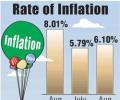
Costlier onion and other vegetables pushed up inflation for the third month in a row to 6.1 per cent in August, making it difficult for the RBI to cut rate in the monetary policy review due later this week.

It bounced back from the historic low of 41 recorded in the April-June quarter, during the initial days of the pandemic and lockdown.

Inflation dipped to a five-month low of 5.19 per cent in July mainly on account of decline in prices of some food articles, vegetables and protein rich items.
The status quo decision came as a breather as only last week the RBI had pulled up banks for not helping it in monetary policy transmission.

Industry chamber Federation of Indian Chambers of Commerce and Industry said the Reserve Bank of India should intervene and cut interest rates.

The main purpose of the meeting is to assess their views on reforms that are required to attract long-term capital into the country.

RBI has cut the rates thrice so far in 2015 by 25 bps each.

The large drop was for export orders that were meant to be delivered until October.

Some investors warned of a coming British or even global recession as sterling collapsed to hit its lowest since 1985.
New Delhi to push for services trade facilitation & food stockpiling.

In 2015, the Reserve Bank of India cut interest rates by 125 basis points to 6.75 per cent.
.jpg)
Prime Minister's key economic advisor C Rangarajan on Friday lowered the growth forecast for the current fiscal to 5.3 per cent from 6.4 per cent projected earlier and listed out host of measures, including further liberalisation of FDI norms to improve economic condition.

Foreign companies see a "lot of turnaround" in India and a "lot of positive attitude" is building towards it, says CII.

Paving the way for the first set of labour reforms in the country, President Pranab Mukherjee has given his assent to Rajasthan's amendments to three laws.

Almost 70 per cent of alcohol distribution in India happens through liquor vends or shops, while 30 per cent happens on-premise, that is, in bars, pubs, and hotels.

States to come under DIPP watch on ease of doing business.

Worried over the fallout of the Supreme Court's observations on allocation of coal blocks, India Inc wants the apex court to consider a reprieve for those allotted to genuine companies that have invested billions.

50-odd biz leaders are part of Modi's entourage for the 3-nation tour

Earlier, an inter-ministerial group used to take these decisions.

The Confederation of Indian Industry has pegged the requirement for investment at Rs 280 lakh crore ($4.7 trillion) for five years beginning 2014-15 to make the economy grow by seven per cent a year on an average.

On November 12, 2021, the Reserve Bank of India (RBI) decided to ring in uniformity in asset classification and income recognition across all lending institutions. Shadow banks, or non-banking financial companies (NBFCs), like commercial banks, are to test non-performing assets (NPAs) on a daily basis and upgrade them to "standard assets" only when interest and principal arrears are settled by borrowers. This is going to create all manner of headaches for shadow banks and their clientele. Says Y S Chakravarti, managing director and chief executive officer (CEO), Shriram City Union Finance: "NPA levels will go up, especially of small borrowers.

NBFCs are facing the heat of a crisis at IL&FS, which defaulted on repayment of its commercial paper dues, leading to a contagion effect in the sector.

Those scheduled to attend the five-day WEF Annual meeting, beginning January 21, include more than 40 heads of state or government, including those from the UK, Australia, Japan, Iran, Israel, Pakistan, Brazil, Italy, Mauritius, Republic of Korea and Switzerland, WEF announced on Wednesday at a press conference in Geneva.

Despite the recent Western criticism on Bangladesh's labour standards, India has a long way to go before it overtakes the neighbour in global exports.

"A Meryl Streep or Jimmy Kimmel can speak their mind, and stay assured that they won't be harmed. That does not happen in India," say Manavi Kapur & Ranjita Ganesan.

The country saw two straight years of deficient monsoons.

India Inc had cheered Donald Trump's decision to scrap TPP, but now there is a growing sense that it won't really lead to positive growth in trade with the US. Subhayan Chakraborty reports.

Industrialists affirm their belief that the adverse effects of demonetisation and the goods and services tax are finally over.

The large current account deficit and the growing vulnerability on the external front have largely contributed towards the secular decline and the current volatility of the rupee.


The ban in India would hit Chinese internet companies that were making headway in the world's fastest-growing mobile market.

Retailer bodies to demand govt action against I-Day sales offers, threaten legal action for breach of FDI rules.
 © 2026 Rediff.com - Advertise with us - Disclaimer - Privacy Policy - Sitemap - Feedback - About us - Terms of use - Grievances